Why Markets May Look Quiet in August After Big Tech Earnings
A lighter calendar can suppress expected stock swings temporarily, while AI spending remains the deeper question for investors.
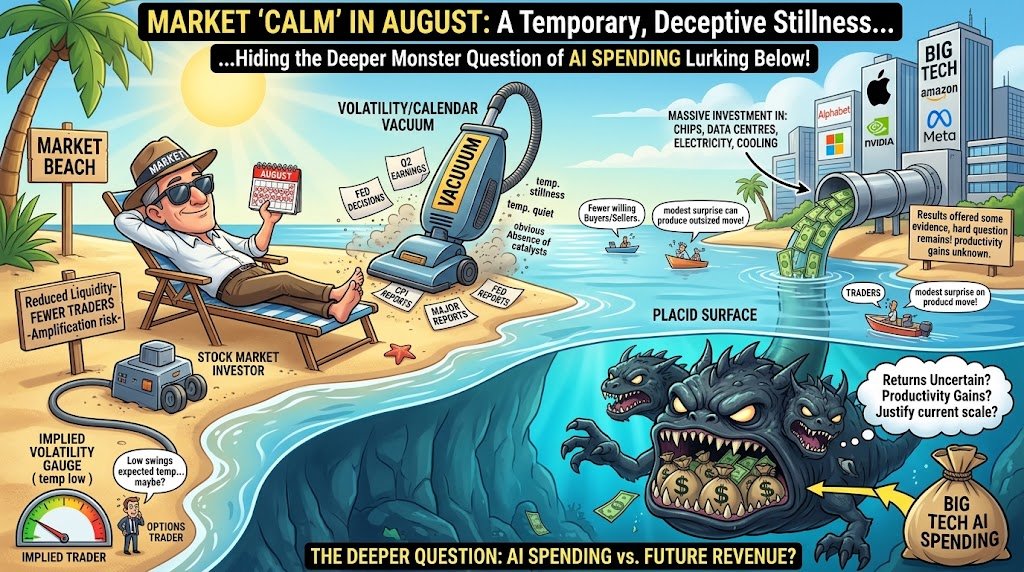
After a closely watched second-quarter earnings season, equity markets may enter a quieter August period with fewer scheduled events forcing investors to rapidly reprice stocks.
That can create what derivatives strategists call a volatility vacuum: not an absence of risk, but a temporary shortage of obvious catalysts.
The distinction matters.
Markets can appear calm because investors are confident, but they can also appear calm because the next decisive piece of information has not arrived.
Central-bank decisions, major economic releases and the biggest corporate earnings reports often concentrate attention into a handful of dates.
Once those events have passed, expected near-term price swings can fall.
The market’s underlying concern has not disappeared.
It remains focused on the largest technology companies and their spending on artificial intelligence.
These companies are investing heavily in chips, data centres, networking equipment and electricity.
Their results have so far offered investors important evidence about demand, but they have also raised the harder question: will the future revenue and productivity gains from AI justify the scale of today’s investment?
That question reaches well beyond technology stocks.
Large cloud operators influence demand for semiconductors, construction, power generation, grid connections and cooling equipment.
Because the largest technology companies carry substantial weight in major stock indexes, their forecasts can shape the mood of the wider market.
Options markets offer one view of this uncertainty.
Options are contracts used to speculate on or protect against changes in asset prices.
Their prices incorporate expected volatility: the size of moves traders think may occur over a given period.
Lower implied volatility suggests expectations of smaller near-term swings.
It does not predict whether stocks will rise or fall, and it offers no assurance against a sudden shock.
August can make the picture more complicated.
Holiday periods often reduce trading activity and liquidity.
In a thinner market, a modest surprise can sometimes produce an outsized move because there are fewer willing buyers or sellers immediately available.
A calm-looking market may therefore be stable, or merely under-responsive until news breaks the stillness.
The next test will arrive with a new catalyst: a change in inflation or employment data, a policy decision, geopolitical developments, or fresh evidence about the returns on AI investment.
Until then, quieter trading should be read as a condition of the calendar and market positioning—not as proof that the risks surrounding valuations and AI spending have been resolved.
That can create what derivatives strategists call a volatility vacuum: not an absence of risk, but a temporary shortage of obvious catalysts.
The distinction matters.
Markets can appear calm because investors are confident, but they can also appear calm because the next decisive piece of information has not arrived.
Central-bank decisions, major economic releases and the biggest corporate earnings reports often concentrate attention into a handful of dates.
Once those events have passed, expected near-term price swings can fall.
The market’s underlying concern has not disappeared.
It remains focused on the largest technology companies and their spending on artificial intelligence.
These companies are investing heavily in chips, data centres, networking equipment and electricity.
Their results have so far offered investors important evidence about demand, but they have also raised the harder question: will the future revenue and productivity gains from AI justify the scale of today’s investment?
That question reaches well beyond technology stocks.
Large cloud operators influence demand for semiconductors, construction, power generation, grid connections and cooling equipment.
Because the largest technology companies carry substantial weight in major stock indexes, their forecasts can shape the mood of the wider market.
Options markets offer one view of this uncertainty.
Options are contracts used to speculate on or protect against changes in asset prices.
Their prices incorporate expected volatility: the size of moves traders think may occur over a given period.
Lower implied volatility suggests expectations of smaller near-term swings.
It does not predict whether stocks will rise or fall, and it offers no assurance against a sudden shock.
August can make the picture more complicated.
Holiday periods often reduce trading activity and liquidity.
In a thinner market, a modest surprise can sometimes produce an outsized move because there are fewer willing buyers or sellers immediately available.
A calm-looking market may therefore be stable, or merely under-responsive until news breaks the stillness.
The next test will arrive with a new catalyst: a change in inflation or employment data, a policy decision, geopolitical developments, or fresh evidence about the returns on AI investment.
Until then, quieter trading should be read as a condition of the calendar and market positioning—not as proof that the risks surrounding valuations and AI spending have been resolved.
AI Disclaimer: An advanced artificial intelligence (AI) system generated the content of this page on its own. This innovative technology conducts extensive research from a variety of reliable sources, performs rigorous fact-checking and verification, cleans up and balances biased or manipulated content, and presents a minimal factual summary that is just enough yet essential for you to function as an informed and educated citizen. Please keep in mind, however, that this system is an evolving technology, and as a result, the article may contain accidental inaccuracies or errors. We urge you to help us improve our site by reporting any inaccuracies you find using the "Contact Us" link at the bottom of this page. Your helpful feedback helps us improve our system and deliver more precise content. When you find an article of interest here, please look for the full and extensive coverage of this topic in traditional news sources, as they are written by professional journalists that we try to support, not replace. We appreciate your understanding and assistance.