UK Drought Cuts Harvests and Raises Food-Security Fears
Record July dryness, repeated heatwaves and water restrictions are reducing crop yields across England and Wales, while farmers warn of mounting pressure on domestic food production.
Britain's drought is beginning to show in its harvests, with farmers reporting weaker yields for cereals and other crops after one of the hottest and driest stretches in recent memory.
The immediate concern is not an established nationwide food shortage, but a shrinking domestic harvest, depleted farm water reserves and the prospect of higher pressure on food supplies if dry conditions persist.
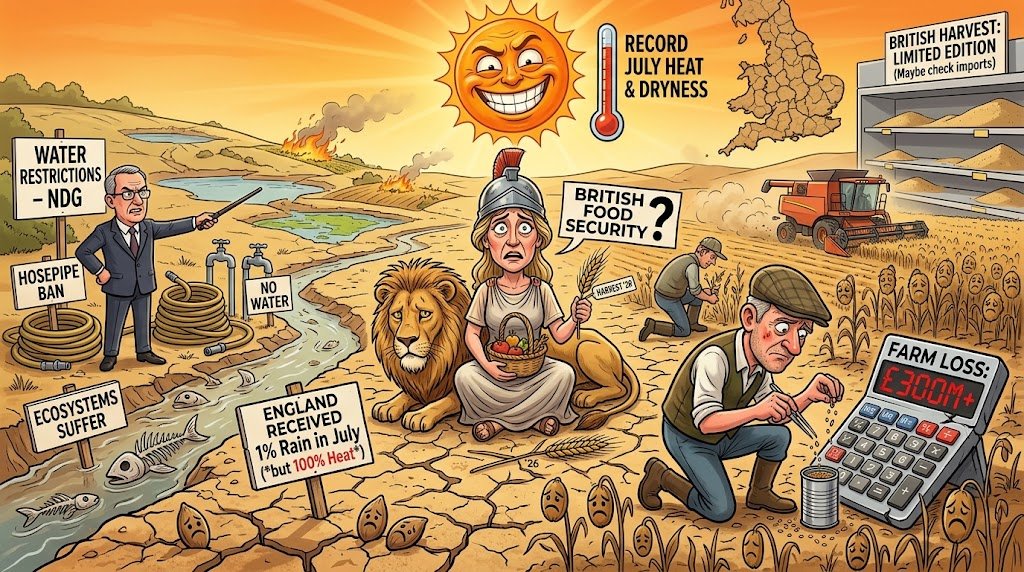
England and Wales recorded their driest July since records began in 1836. England received only 7% of its long-term average rainfall for the month, while some parts of southern England received about 1%.
The combination of prolonged dryness and repeated heatwaves has left soils parched, reduced river flows and intensified competition for water between households, businesses, ecosystems and agriculture.
More than half of England was formally placed in drought on 29 July, covering East Anglia, London, the Thames Valley, Hampshire and the Isle of Wight, Devon and Cornwall, the West Midlands and Wessex.
Wales has also declared a nationwide drought.
Millions of people are subject to temporary restrictions on water use, while regulators have tightened controls on the amount of water that can be taken from rivers and groundwater for irrigation.
For growers, the damage is already being measured in the fields.
John Pawsey, a farmer in Suffolk, said early results from crops including oats, wheat and vetch showed yields down by between 25% and 30%.
His experience is not a national measure, but it reflects the wider strain on arable farms, which have faced early harvesting, poor soil moisture and sharply reduced access to irrigation water.
Provisional agricultural estimates indicate that wheat, spring barley and oats are yielding below their 10-year averages.
An analysis based on early harvest data estimates that total cereal and oilseed production could reach 19.5 million tonnes, which would make the 2026 harvest the weakest in records going back to 1984. That estimate remains provisional, but it suggests output could be up to 2.5 million tonnes below earlier forecasts made before the summer heatwaves and drought intensified.
The financial effect on farmers could be severe.
Using current farm-gate prices, the gap between the earlier production forecasts and the updated yield outlook has been estimated at between £305 million and £390 million.
Livestock farmers are also confronting weaker grass growth and concerns over forage supplies, raising the risk that winter feed will have to be used earlier than planned.
The drought has consequences beyond farming.
Official monitoring shows that river flows, groundwater levels and reservoir storage have continued to decline across much of England.
Authorities have reported algal blooms, fish deaths, falling water quality and a greater risk of field and wildfires.
Reservoirs were strengthened by a wet winter, helping to protect household supplies for now, but continued hot weather has increased evaporation and demand.
The government has ordered enhanced drought monitoring, water companies have been directed to follow their drought plans and reduce leakage, and the National Drought Group is coordinating the response with regulators, farmers and water providers.
Rain forecast in the coming days may bring local relief, but officials say it is not expected to restore water resources materially without a sustained period of widespread rainfall.
The immediate concern is not an established nationwide food shortage, but a shrinking domestic harvest, depleted farm water reserves and the prospect of higher pressure on food supplies if dry conditions persist.
England and Wales recorded their driest July since records began in 1836. England received only 7% of its long-term average rainfall for the month, while some parts of southern England received about 1%.
The combination of prolonged dryness and repeated heatwaves has left soils parched, reduced river flows and intensified competition for water between households, businesses, ecosystems and agriculture.
More than half of England was formally placed in drought on 29 July, covering East Anglia, London, the Thames Valley, Hampshire and the Isle of Wight, Devon and Cornwall, the West Midlands and Wessex.
Wales has also declared a nationwide drought.
Millions of people are subject to temporary restrictions on water use, while regulators have tightened controls on the amount of water that can be taken from rivers and groundwater for irrigation.
For growers, the damage is already being measured in the fields.
John Pawsey, a farmer in Suffolk, said early results from crops including oats, wheat and vetch showed yields down by between 25% and 30%.
His experience is not a national measure, but it reflects the wider strain on arable farms, which have faced early harvesting, poor soil moisture and sharply reduced access to irrigation water.
Provisional agricultural estimates indicate that wheat, spring barley and oats are yielding below their 10-year averages.
An analysis based on early harvest data estimates that total cereal and oilseed production could reach 19.5 million tonnes, which would make the 2026 harvest the weakest in records going back to 1984. That estimate remains provisional, but it suggests output could be up to 2.5 million tonnes below earlier forecasts made before the summer heatwaves and drought intensified.
The financial effect on farmers could be severe.
Using current farm-gate prices, the gap between the earlier production forecasts and the updated yield outlook has been estimated at between £305 million and £390 million.
Livestock farmers are also confronting weaker grass growth and concerns over forage supplies, raising the risk that winter feed will have to be used earlier than planned.
The drought has consequences beyond farming.
Official monitoring shows that river flows, groundwater levels and reservoir storage have continued to decline across much of England.
Authorities have reported algal blooms, fish deaths, falling water quality and a greater risk of field and wildfires.
Reservoirs were strengthened by a wet winter, helping to protect household supplies for now, but continued hot weather has increased evaporation and demand.
The government has ordered enhanced drought monitoring, water companies have been directed to follow their drought plans and reduce leakage, and the National Drought Group is coordinating the response with regulators, farmers and water providers.
Rain forecast in the coming days may bring local relief, but officials say it is not expected to restore water resources materially without a sustained period of widespread rainfall.
AI Disclaimer: An advanced artificial intelligence (AI) system generated the content of this page on its own. This innovative technology conducts extensive research from a variety of reliable sources, performs rigorous fact-checking and verification, cleans up and balances biased or manipulated content, and presents a minimal factual summary that is just enough yet essential for you to function as an informed and educated citizen. Please keep in mind, however, that this system is an evolving technology, and as a result, the article may contain accidental inaccuracies or errors. We urge you to help us improve our site by reporting any inaccuracies you find using the "Contact Us" link at the bottom of this page. Your helpful feedback helps us improve our system and deliver more precise content. When you find an article of interest here, please look for the full and extensive coverage of this topic in traditional news sources, as they are written by professional journalists that we try to support, not replace. We appreciate your understanding and assistance.