Hungary After the Landslide — A Strategic Reset in Europe
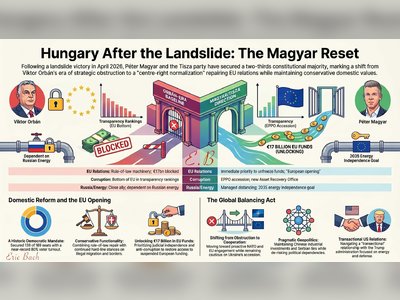
As of 18 April 2026, Péter Magyar is best described as Hungary’s prime minister-elect rather than its formally installed prime minister. His Tisza party won the 12 April 2026parliamentary election in a landslide, taking 138 of 199 seats, around 53% of the vote, and 94 of 106 individual districts after a record or near-record turnout of roughly 78% to 80%. Magyar has asked for parliament to convene quickly and has said he wants a handover by 5 May 2026. This report therefore assesses the outlook for an incoming Magyar governmentwith a two-thirds constitutional majority.
The strategic opportunity is unusually large. Magyar has three rare assets at once: a fresh democratic mandate; an electorate that clearly wants better public services, less corruption, and a more functional relationship with Europe; and an external environment in which Brussels and markets are visibly inclined to reward credible reform quickly. The first meetings between EU officials and Magyar’s team are already focused on restoring judicial independence, media and academic freedom, anti-corruption compliance, and unlocking around €17 billion in suspended or blocked EU money. Markets have reacted positively: after Orbán’s defeat, the forint jumped to a multi-year high and the Budapest stock market rallied as investors priced in an improved chance of EU fund inflows and more predictable policymaking.
The opening, however, is not the same as an easy transition. Magyar inherits a state whose institutions were heavily shaped by Fidesz, whose public finances remain stretched, and whose geopolitical relationships are entangled with Russian energy, Chinese industrial investment, and a now-Trump-led Washington that had invested politically in Viktor Orbán. The European Commission’s 2025 Rule of Law Report still recorded no progress on public-media independence, lobbying and revolving-door reform, effective asset-declaration enforcement, and removing obstacles affecting civil society, including the immigration tax. Independent assessments continue to place Hungary at the bottom of the EU on corruption perceptions and in a weak position on media freedom and civic space.
The core judgement of this report is positive. Magyar has a credible chance to turn a political earthquake into a governance and investment reset. The most likely successful path is not a wholesale ideological inversion of Orbánism. It is a centre-right European normalisation: harder-edged on corruption and institutional repair, much more cooperative with the EU and NATO, but still conservative on migration, cautious on rapid Ukrainian accession, and pragmatic on Serbia, Russia and China. Tisza’s own programme makes this clear. It rejects EU migration quotas and the migration pact, promises to keep the southern border fence and maintain zero tolerance for illegal immigration, while simultaneously promising a European opening, rule-of-law repair, and the unfreezing of EU funds.
That nuance matters because Orbán’s legacy is not only institutional distortion. He also leaves behind tangible state capabilities and strategic assets that a Magyar government should preserve where possible: a still-tight labour market, sharply lower inflation than Hungary suffered in the 2022–2024 period, a powerful EV and battery manufacturing base, deepened strategic ties with Serbia, and a country that remains consequential in NATO and European energy routes. Orbán also retains a large political base: even in defeat, AP reported that Fidesz still won 2.4 million votes, enough to remain a formidable opposition. The winning formula for Magyar is therefore likely to be repair and professionalisation, not simple demolition.
Mandate and Strategic Baseline
Magyar’s mandate is real and unusually strong, but it should not be mistaken for unqualified national consensus. The election ended Orbán’s 16-year tenure, but it did not erase the social coalition that sustained him. Orbán conceded quickly and has since called for a “complete renewal” inside Fidesz while signalling that he intends to remain involved in rebuilding the party. That means Magyar starts with constitutional power, but not with a politically empty field.
The voter message appears broad rather than narrowly ideological. Cambridge researchers summarising the result highlighted dissatisfaction with corruption, economic stagnation, high prices, low wages, anti-Ukraine and anti-Western rhetoric, and serious problems in healthcare, education and child protection. Tisza’s own platform likewise frames “a functioning Hungary” around hospitals, schools, housing, pension security, clean government and European belonging.
That also helps explain why a generally positive assessment of Magyar need not become an indiscriminate negative judgement on Orbán. The better reading is that many Hungarians voted to correct the system, not to repudiate every conservative instinct of the last decade and a half. Tisza has kept hard lines on illegal migration and border control, opposes fast-track Ukrainian accession to the EU, and wants sovereign but more credible foreign policy positioning. In other words, Magyar’s coalition is offering a post-Orbán conservatism with European functionality, not a left-liberal revolution.
The election also came with structural caveats. ODIHR’s preliminary statement on the 2026 vote said the legal framework still limits inclusiveness and collegiality in election administration, especially because only the president of the National Election Commission can propose decisions and a 2022 amendment removed voting rights from non-parliamentary party delegates. That matters because the landslide solved the immediate transfer-of-power question, but it did not itself repair the institutional design problem.
Comparative policy direction
| Policy area | Orbán-era baseline | Magyar/Tisza direction | Strategic reading |
|---|---|---|---|
| EU relations and EU funds | Hungary remained under the EU’s rule-of-law conditionality machinery; €6.3bn in cohesion commitments were suspended in 2022, RRF disbursement remained tied to 27 “super milestones”, and broader blocked/suspended sums are now commonly estimated at around €17bn. | Magyar has made unfreezing EU funds an immediate priority and Tisza’s foreign-policy team has pushed for an “European opening” and repair of ties with Brussels and Warsaw. | Clear discontinuity in tone and process; high probability of a rapid reset if reforms are credible. |
| Rule of law and anti-corruption | The Commission still reports no progress on lobbying/revolving-doors reform, asset-declaration enforcement, public-media independence, or removing civil-society obstacles; Transparency International Hungary again put Hungary at the bottom of the EU in CPI 2025. | Magyar has promised constitutional change, an anti-corruption drive, an asset-recovery office, EPPO accession, and a corruption whistleblowing “Immunity Programme”. | Strong discontinuity; this is the most valuable domain for quick credibility gains. |
| Media and civil society | RSF ranked Hungary 68th of 180in 2025 and described a media landscape exposed to political, economic and regulatory pressure; the Commission reported no progress on public-media independence or civil-society space. | Magyar says public media’s news service should be suspended until balanced conditions are restored; Tisza also proposes campaign-ad controls and tighter oversight of quasi-civil political spenders. | Major discontinuity, but execution risk is high because overcorrection could itself create legitimacy issues. |
| Economy, fiscal policy and euro | KSH reported 1.8% inflation in March 2026 and 4.8%unemployment in February 2026, but the 2024 general-government deficit was 5.0% of GDP and debt stood at 73.5% of GDP; the Commission expects 2.5% growth in 2026 but warns of tariff risk and high financing costs. | Tisza wants tax relief for lower earners, VAT cuts on essentials, a wealth tax above HUF 1bn, KATA restoration, Maastricht compliance by 2030, and the deficit below 3%through anti-corruption and procurement savings. | Mixed: strong pro-growth and pro-household rhetoric, but fiscal arithmetic will be tight. |
| Migration and border control | Orbán built his brand around hard-line migration control; Hungary was fined €200m plus €1m per day by the ECJ over non-compliance with EU asylum law. | Tisza rejects migration quotas and the EU migration pact, promises to keep the southern border fence, and maintains zero tolerance for illegal migration and trafficking. | More continuity than many EU observers may expect. |
| Russia and Ukraine | Orbán was described by AP as Russia’s closest ally inside the EU, repeatedly blocked or delayed Ukraine-related EU moves, and fought EU plans to phase out Russian energy. | Magyar is more cooperative with the EU and NATO, open to compromise on EU-wide Ukraine aid, and says he would urge Putin to end the war, but he also opposes rapid Ukrainian EU accession. | Directional shift without full strategic rupture. |
| China and industrial policy | Orbán made Hungary a flagship destination for Chinese EV and battery investment, including CATL and BYD. | Beijing officially congratulated Tisza and said it is ready to work with the new government “on the basis of mutual respect, equality, and mutual benefit”; Magyar is likely to keep projects but scrutinise standards more tightly. | Commercial continuity likely; political de-risking likely. |
| Serbia and the Western Balkans | Serbia-Hungary ties reached what both sides called record strength, including a strategic defence agreement and Hungarian support for Serbia’s EU path. | Vučić has already congratulated Magyar and explicitly said he expects strong cooperation to continue, while thanking Orbán for building it. | Significant continuity, though likely in a less personalised form. |
Domestic Reform Agenda and Institutional Reset
For Magyar, the fastest route to durable legitimacy is to make his first year look boring in the best sense: legally clean, procedurally credible, institutionally calming, and visibly useful to ordinary people. The temptation of a two-thirds majority is to move fast because one can. The smarter use of a two-thirds majority is to move fast only where speed restores credibility, and move more carefully where speed could look like simple winner’s justice. That distinction is critical because analysts have warned that Fidesz loyalists remain embedded across the presidency, Constitutional Court, senior judiciary, prosecutor’s office, and central bank, all of which can act as veto players or friction points.
The first legislative cluster should be the one Brussels and investors can verify almost immediately. That means judicial independence, lobbying and revolving-door rules, stronger asset-declaration oversight, public-procurement cleanup, campaign-finance transparency, and some visible route toward EPPO participation. Tisza has already foreshadowed much of this: it wants campaign-spending caps restored, government advertising restrained, party finances monitored by a genuinely independent body, and anti-corruption reporting scaled up through its own Immunity Programme. The party also explicitly promises to bring back EU funds, restore conservative fiscal planning, and push debt and inflation onto a declining path.
This is where Magyar’s programme is strongest. It aligns domestic reform, market confidence and EU conditionality rather than treating them as separate fields. The Commission’s 2025 rule-of-law package explicitly notes that rule-of-law conditions matter for the functioning of the single market and for companies operating across borders. In consultancy terms, this means Magyar’s best early-return investment is not a large spending package but a credibility package. Every day saved in restoring procurement integrity, judicial autonomy and media governance potentially shortens the interval before EU money and lower risk premia begin to work for him.
Media reform is both more urgent and more delicate. The baseline is adverse: the Commission reported no progress on strengthening the independent governance and editorial independence of public-service media, RSF still places Hungary in the lower reaches of the EU, and both CIVICUS and Amnesty continue to describe civic space as obstructed and subject to harassment tools including the sovereignty-protection apparatus. Magyar’s own rhetoric is muscular: he has called state media a propaganda machine and says he would suspend its news service until objective conditions are restored. That can be politically popular, but for a government claiming to restore normal constitutional standards, the method matters as much as the goal. The lasting answer is not simply silencing one megaphone and replacing it with another; it is building a governance model consistent with the European Media Freedom Actand insulated from any party’s capture.
Civil-society repair belongs in the same early package. The Commission’s 2024 and 2025 reports both emphasised the lack of progress in removing obstacles affecting civil society, especially the immigration tax, while CIVICUS and Hungarian rights groups say the trend of shrinking civic space continued through 2024 and 2025. A Magyar government that wants to look substantively, not merely rhetorically, European should therefore prioritise repealing or amending those civic-space restrictions quickly. This is one of the few areas where a limited number of legislative acts could produce a disproportionately large international confidence gain.
A broader governance caution is worth stating plainly. AP noted that some observers are already warning about the unchecked power that comes with another constitutional supermajority. That warning should not be dismissed. Magyar’s political asset is that he is arriving as the anti-capture candidate. If the first year looks like re-capture by a new bloc, he loses the moral asymmetry that powered the landslide. The shrewd way to use extraordinary power is to reduce the amount of extraordinary power any future Hungarian government can exercise. His proposed two-term cap for prime ministers fits that logic and could become the symbolic centrepiece of a wider de-concentration package.
Economic Policy, Markets and Delivery Capacity
The macro starting point is better than Hungary’s politics might suggest, but worse than a victory speech might imply. Inflation has dropped sharply, reaching 1.8% year on year in March 2026, and unemployment remains comparatively low at 4.8% in February 2026. Yet the National Bank of Hungary’s base rate is still high at 6.25%, and the fiscal position remains the real binding constraint: KSH put the 2024 deficit at 5.0% of GDP and public debt at 73.5%, while the European Commission expects the deficit to remain elevated in 2025 and widen to 5.2% in 2026 absent policy change. The Council’s excessive-deficit procedure requires Hungary to correct the deficit by 2026 and keep net expenditure growth within tight limits.
This means Magyar’s economic challenge is not simply “growth versus austerity”. It is credibility-first consolidation with targeted relief. Tisza’s programme is politically intelligent: more disposable income for low earners, lower VAT on basic items, a wealth tax above HUF 1 billion, simpler rules for small business, and a stated ambition to meet Maastricht criteria by 2030. Those measures could help households and improve perceptions of fairness. But they also require either stronger growth, much better tax compliance, meaningful anti-corruption savings, faster EU disbursement, or all of the above. Hungarian media citing Niveus Consulting has already warned the tax package could reduce annual revenue by as much as HUF 1.5 trillion if behavioural and growth offsets do not materialise.
The market’s initial response tells Magyar where the opportunity lies. Reuters reported that the forint jumped roughly 2% to 2.5% after Orbán’s defeat, reaching a multi-year high, while the Budapest stock exchange rose almost 3%, largely on expectations that frozen EU funds might start to flow. This is a vote of confidence, but it is also a warning. Markets are not rewarding ideology; they are rewarding the prospect of administrative normalisation, better EU relations, and lower policy risk. If reforms get bogged down or fiscal loosening gets ahead of financing, the same markets could reverse quickly.
The central economic upside is straightforward. If even part of the roughly €17 billion in frozen or suspended EU money becomes accessible, Hungary could simultaneously ease budget pressure, restart public investment, finance social-sector catch-up, and improve trend growth. The urgency is real: AP reports that talks with the EU concern around
Newsletter
Related Articles