The Ten World Cup Finals That Defined Football History
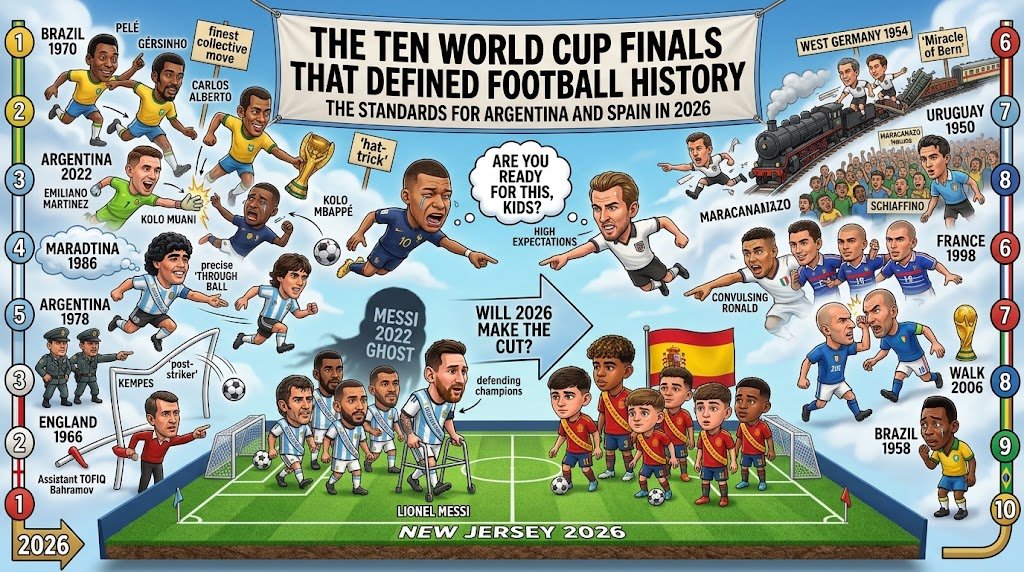
From Pelé’s emergence in Sweden and Uruguay’s shock at the Maracanã to Zidane’s final act and Messi’s triumph in Qatar, these matches set the standard awaiting Argentina and Spain in the 2026 final.
Argentina and Spain will enter the 2026 World Cup final carrying the ingredients of a historic occasion: the defending champions against the reigning European champions, Lionel Messi at thirty-nine against a Spanish side led by a new generation, and the possibility of Argentina becoming the first nation since Brazil in 1962 to retain the trophy.
Yet reputation, symbolism and anticipation do not make a great final by themselves.
The match must also produce the football, tension or human drama that survives long after the result.
That distinction matters because the World Cup final has repeatedly delivered more than a champion.
Its greatest editions have launched careers, broken national confidence, transformed players into symbols and produced controversies that remain unresolved decades later.
The following ranking measures not only technical quality, but also competitive tension, historical consequence and the durability of the images each match left behind.
At number ten is Brazil’s 5–2 victory over Sweden in 1958, the afternoon when the wider football world first encountered Pelé.
Brazil fell behind against the host nation before Vavá scored twice and a gifted attacking side took control.
Garrincha unsettled the Swedish defence, Didi conducted play from midfield and the seventeen-year-old Pelé scored twice.
His first goal, lifting the ball over a defender before striking it on the volley, became one of the tournament’s defining images.
Brazil won its first World Cup, while Pelé’s tears at full time marked the arrival of the player who would become the competition’s most enduring icon.
Italy’s penalty-shootout victory over France in 2006 ranks ninth because its decisive image was not a goal but an expulsion.
Zinedine Zidane gave France the lead with an audacious chipped penalty before Marco Materazzi equalised with a header.
Deep into extra time, after an exchange between the two scorers, Zidane drove his head into Materazzi’s chest and was sent off in the final match of his career.
Italy converted all five of its penalties to win a fourth world title.
Zidane’s walk past the trophy on his way to the dressing room remains one of football’s starkest portraits of brilliance ending in self-destruction.
France’s 3–0 defeat of Brazil in 1998 occupies eighth place.
The uncertainty surrounding Ronaldo dominated the hours before kickoff after the Brazilian forward suffered a convulsive episode, was initially removed from the starting lineup and then reinstated.
Once the match began, France controlled it.
Zidane scored two headers from corners, Emmanuel Petit added a late third and the host nation claimed its first World Cup.
The victory also acquired a larger civic meaning inside France: a multicultural national team, led by the son of Algerian immigrants, became a temporary emblem of national cohesion.
The 1950 meeting between Uruguay and Brazil is seventh, although it was technically the last fixture of a four-team final round rather than a conventional final.
Brazil needed only a draw and took the lead through Friaça before an enormous crowd at the Maracanã.
Uruguay equalised through Juan Alberto Schiaffino, then Alcides Ghiggia scored the winner to secure a 2–1 victory.
The silence inside the stadium became almost as famous as the result.
Brazil named the trauma the Maracanazo, the blow of the Maracanã, and the defeat became part of the country’s national memory even as later generations accumulated five world titles.
West Germany’s 3–2 victory over Hungary in 1954 ranks sixth.
Hungary entered the final unbeaten for four years and had defeated the same opponent 8–3 during the group stage.
Ferenc Puskás and Zoltán Czibor put the favourites two goals ahead inside eight minutes, but Max Morlock quickly reduced the deficit and Helmut Rahn equalised.
Rahn scored again in the eighty-fourth minute to complete one of the greatest reversals in international football.
The Miracle of Bern became a symbol of West Germany’s postwar recovery, although later allegations that German players may have received performance-enhancing injections placed a lasting shadow over the triumph.
No conclusive finding has overturned the result.
England’s 4–2 extra-time victory over West Germany in 1966 stands fifth.
Geoff Hurst’s second goal remains the most disputed moment in World Cup final history.
His shot struck the crossbar, bounced down near the line and was awarded after the referee consulted assistant Tofiq Bahramov.
Hurst later completed the only hat-trick scored in a men’s World Cup final until Kylian Mbappé matched the feat in 2022. England won its first and, so far, only world title.
The argument over whether the ball fully crossed the line has outlived nearly everyone involved.
Argentina’s 3–1 extra-time victory over the Netherlands in 1978 ranks fourth.
The host nation staged the tournament under a military dictatorship that sought political advantage from the event.
On the field, Mario Kempes gave Argentina the lead before Dick Nanninga equalised late in normal time.
Rob Rensenbrink then struck the post in the final seconds, coming within centimetres of winning the World Cup for the Dutch.
Kempes restored Argentina’s advantage during extra time and Daniel Bertoni completed the victory, delivering the country’s first title amid celebrations inseparable from the authoritarian setting in which they occurred.
Argentina’s 3–2 victory over West Germany in 1986 is third.
José Luis Brown and Jorge Valdano established a two-goal lead, but Karl-Heinz Rummenigge and Rudi Völler scored seven minutes apart to bring West Germany level.
With momentum shifting, Diego Maradona produced the pass that resolved the final.
His precise through ball released Jorge Burruchaga, who ran beyond the defence and scored the winner.
Maradona did not score in the match, but the assist completed an extraordinary individual tournament and secured Argentina’s second World Cup.
The 2022 final between Argentina and France ranks second.
Argentina led 2–0 and controlled the match for nearly eighty minutes before Mbappé scored twice in less than two minutes.
Messi restored Argentina’s lead in extra time, only for Mbappé to complete his hat-trick from the penalty spot.
Emiliano Martínez then denied Randal Kolo Muani with a crucial late save before Argentina prevailed 4–2 in the shootout.
Messi finally lifted the World Cup, while Mbappé became only the second player to score three times in a men’s final.
The match combined elite performance, abrupt reversals and individual rivalry at a level rarely seen on the sport’s largest stage.
Brazil’s 4–1 victory over Italy in 1970 remains the benchmark.
Pelé opened the scoring with a header, Roberto Boninsegna equalised and Gérson restored Brazil’s lead with a powerful shot from outside the penalty area.
Jairzinho scored the third, becoming the first player to find the net in every match of a single World Cup, before Carlos Alberto completed one of football’s finest collective moves.
Brazil’s patient sequence of passes drew Italy across the field, Pelé paused and released the advancing captain, and Carlos Alberto drove the ball into the far corner.
The victory delivered Brazil’s third championship and permanent possession of the Jules Rimet Trophy.
More than half a century later, it remains the clearest example of a dazzling attacking team reproducing its finest football under the pressure of a World Cup final.
Argentina and Spain will now play for the same permanence in New Jersey.
The result will decide the champion, but the quality and drama of the contest will determine whether the 2026 final joins the small group of matches remembered as more than victories.
Yet reputation, symbolism and anticipation do not make a great final by themselves.
The match must also produce the football, tension or human drama that survives long after the result.
That distinction matters because the World Cup final has repeatedly delivered more than a champion.
Its greatest editions have launched careers, broken national confidence, transformed players into symbols and produced controversies that remain unresolved decades later.
The following ranking measures not only technical quality, but also competitive tension, historical consequence and the durability of the images each match left behind.
At number ten is Brazil’s 5–2 victory over Sweden in 1958, the afternoon when the wider football world first encountered Pelé.
Brazil fell behind against the host nation before Vavá scored twice and a gifted attacking side took control.
Garrincha unsettled the Swedish defence, Didi conducted play from midfield and the seventeen-year-old Pelé scored twice.
His first goal, lifting the ball over a defender before striking it on the volley, became one of the tournament’s defining images.
Brazil won its first World Cup, while Pelé’s tears at full time marked the arrival of the player who would become the competition’s most enduring icon.
Italy’s penalty-shootout victory over France in 2006 ranks ninth because its decisive image was not a goal but an expulsion.
Zinedine Zidane gave France the lead with an audacious chipped penalty before Marco Materazzi equalised with a header.
Deep into extra time, after an exchange between the two scorers, Zidane drove his head into Materazzi’s chest and was sent off in the final match of his career.
Italy converted all five of its penalties to win a fourth world title.
Zidane’s walk past the trophy on his way to the dressing room remains one of football’s starkest portraits of brilliance ending in self-destruction.
France’s 3–0 defeat of Brazil in 1998 occupies eighth place.
The uncertainty surrounding Ronaldo dominated the hours before kickoff after the Brazilian forward suffered a convulsive episode, was initially removed from the starting lineup and then reinstated.
Once the match began, France controlled it.
Zidane scored two headers from corners, Emmanuel Petit added a late third and the host nation claimed its first World Cup.
The victory also acquired a larger civic meaning inside France: a multicultural national team, led by the son of Algerian immigrants, became a temporary emblem of national cohesion.
The 1950 meeting between Uruguay and Brazil is seventh, although it was technically the last fixture of a four-team final round rather than a conventional final.
Brazil needed only a draw and took the lead through Friaça before an enormous crowd at the Maracanã.
Uruguay equalised through Juan Alberto Schiaffino, then Alcides Ghiggia scored the winner to secure a 2–1 victory.
The silence inside the stadium became almost as famous as the result.
Brazil named the trauma the Maracanazo, the blow of the Maracanã, and the defeat became part of the country’s national memory even as later generations accumulated five world titles.
West Germany’s 3–2 victory over Hungary in 1954 ranks sixth.
Hungary entered the final unbeaten for four years and had defeated the same opponent 8–3 during the group stage.
Ferenc Puskás and Zoltán Czibor put the favourites two goals ahead inside eight minutes, but Max Morlock quickly reduced the deficit and Helmut Rahn equalised.
Rahn scored again in the eighty-fourth minute to complete one of the greatest reversals in international football.
The Miracle of Bern became a symbol of West Germany’s postwar recovery, although later allegations that German players may have received performance-enhancing injections placed a lasting shadow over the triumph.
No conclusive finding has overturned the result.
England’s 4–2 extra-time victory over West Germany in 1966 stands fifth.
Geoff Hurst’s second goal remains the most disputed moment in World Cup final history.
His shot struck the crossbar, bounced down near the line and was awarded after the referee consulted assistant Tofiq Bahramov.
Hurst later completed the only hat-trick scored in a men’s World Cup final until Kylian Mbappé matched the feat in 2022. England won its first and, so far, only world title.
The argument over whether the ball fully crossed the line has outlived nearly everyone involved.
Argentina’s 3–1 extra-time victory over the Netherlands in 1978 ranks fourth.
The host nation staged the tournament under a military dictatorship that sought political advantage from the event.
On the field, Mario Kempes gave Argentina the lead before Dick Nanninga equalised late in normal time.
Rob Rensenbrink then struck the post in the final seconds, coming within centimetres of winning the World Cup for the Dutch.
Kempes restored Argentina’s advantage during extra time and Daniel Bertoni completed the victory, delivering the country’s first title amid celebrations inseparable from the authoritarian setting in which they occurred.
Argentina’s 3–2 victory over West Germany in 1986 is third.
José Luis Brown and Jorge Valdano established a two-goal lead, but Karl-Heinz Rummenigge and Rudi Völler scored seven minutes apart to bring West Germany level.
With momentum shifting, Diego Maradona produced the pass that resolved the final.
His precise through ball released Jorge Burruchaga, who ran beyond the defence and scored the winner.
Maradona did not score in the match, but the assist completed an extraordinary individual tournament and secured Argentina’s second World Cup.
The 2022 final between Argentina and France ranks second.
Argentina led 2–0 and controlled the match for nearly eighty minutes before Mbappé scored twice in less than two minutes.
Messi restored Argentina’s lead in extra time, only for Mbappé to complete his hat-trick from the penalty spot.
Emiliano Martínez then denied Randal Kolo Muani with a crucial late save before Argentina prevailed 4–2 in the shootout.
Messi finally lifted the World Cup, while Mbappé became only the second player to score three times in a men’s final.
The match combined elite performance, abrupt reversals and individual rivalry at a level rarely seen on the sport’s largest stage.
Brazil’s 4–1 victory over Italy in 1970 remains the benchmark.
Pelé opened the scoring with a header, Roberto Boninsegna equalised and Gérson restored Brazil’s lead with a powerful shot from outside the penalty area.
Jairzinho scored the third, becoming the first player to find the net in every match of a single World Cup, before Carlos Alberto completed one of football’s finest collective moves.
Brazil’s patient sequence of passes drew Italy across the field, Pelé paused and released the advancing captain, and Carlos Alberto drove the ball into the far corner.
The victory delivered Brazil’s third championship and permanent possession of the Jules Rimet Trophy.
More than half a century later, it remains the clearest example of a dazzling attacking team reproducing its finest football under the pressure of a World Cup final.
Argentina and Spain will now play for the same permanence in New Jersey.
The result will decide the champion, but the quality and drama of the contest will determine whether the 2026 final joins the small group of matches remembered as more than victories.
AI Disclaimer: An advanced artificial intelligence (AI) system generated the content of this page on its own. This innovative technology conducts extensive research from a variety of reliable sources, performs rigorous fact-checking and verification, cleans up and balances biased or manipulated content, and presents a minimal factual summary that is just enough yet essential for you to function as an informed and educated citizen. Please keep in mind, however, that this system is an evolving technology, and as a result, the article may contain accidental inaccuracies or errors. We urge you to help us improve our site by reporting any inaccuracies you find using the "Contact Us" link at the bottom of this page. Your helpful feedback helps us improve our system and deliver more precise content. When you find an article of interest here, please look for the full and extensive coverage of this topic in traditional news sources, as they are written by professional journalists that we try to support, not replace. We appreciate your understanding and assistance.