
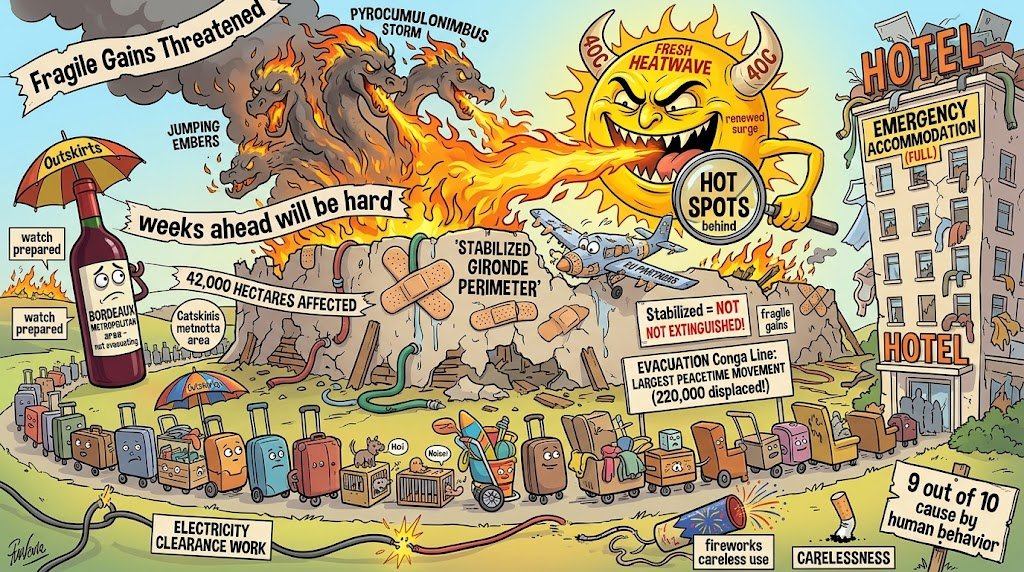
Fresh Heatwave Threatens to Rekindle France’s Historic Wildfire Crisis
A vast Gironde fire has displaced 220,000 people as rising temperatures and deepening drought renew the danger across France and Spain.
A renewed surge of extreme heat is threatening to reverse fragile gains against the wildfires sweeping France and Spain, with temperatures around 40C forecast in parts of both countries and increasingly dry vegetation widening the territory vulnerable to ignition.
French President Emmanuel Macron warned that the coming weeks would be difficult as emergency services confronted fires on a scale that has overwhelmed local resources, displaced entire communities and exposed weaknesses in Europe’s preparations for a longer, more volatile fire season.
The most destructive French blaze began near Saumos in the Gironde department on July 22 and spread rapidly through forest west of Bordeaux.
Driven by drought, extreme heat and shifting winds, it affected approximately 42,000 hectares within five days.
More than 220,000 residents and holidaymakers were evacuated, including people in Lège-Cap-Ferret, Arès, Andernos-les-Bains, Le Porge and several communities closer to the Bordeaux metropolitan area.
Authorities described the evacuation as one of France’s largest peacetime population movements.
Bordeaux itself, a city of roughly 268,000 people, was not under an evacuation order, although contingency preparations continued as the fire approached within about 15 kilometres of its outskirts.
Roads, railway services and tourism were heavily disrupted, while emergency accommodation filled with displaced families and seasonal visitors.
By July 27, the fire’s perimeter had stopped expanding and officials classified it as stabilised.
That designation did not mean the blaze was controlled or extinguished.
Numerous hot spots remained inside the affected area, capable of flaring again as temperatures rose, humidity fell or winds strengthened.
The fire also produced a pyrocumulonimbus cloud, an immense thunderstorm generated by the heat and smoke of an exceptionally intense blaze.
The phenomenon can create powerful internal winds, lightning and abrupt changes in fire direction.
Lightning from the Gironde firestorm ignited additional outbreaks, while airborne embers allowed flames to leap over defensive lines and start new fires as far as a kilometre away.
About 2,500 firefighters, supported by soldiers, police officers, gendarmes and firefighting aircraft, were deployed around the Gironde front.
At least 84 firefighters were injured.
More than 240 homes were reported destroyed or damaged, and millions of high-filtration masks were distributed as smoke degraded air quality.
European partners supplied aircraft and ground crews through the continent’s civil-protection system after France requested assistance.
Macron visited the departmental fire and rescue operations centre in Bordeaux on July 27, received an operational briefing and met emergency personnel and local officials.
He pledged full state support and said, “The weeks ahead will be hard.” His warning reflected the distinction between containing the present fires and enduring the rest of a season in which repeated heatwaves have progressively depleted moisture from forests, scrubland and agricultural vegetation.
Investigators believe the Saumos blaze began during vegetation-clearance work at a site operated by the electricity-distribution network.
The work was reportedly being conducted within existing rules, and no finding of criminal responsibility had been established.
Authorities separately detained people suspected of starting unrelated fires, including incidents involving fireworks, as officials again appealed for caution around forests and dry grassland.
Human activity causes approximately nine out of every 10 forest fires in France, with about half attributed to carelessness or hazardous conduct.
Climate change does not ignite those fires directly, but hotter conditions, prolonged drought and more frequent heatwaves dry the available fuel, increasing the likelihood that an ordinary spark will become an uncontrollable conflagration.
Four-fifths of French wildfires begin within 50 metres of buildings, placing human behaviour and land management at the centre of prevention.
France had recorded 116,085 hectares affected by fire during 2026 by late July, already an exceptional national total.
The Gironde disaster alone approached the scale of the country’s catastrophic 1949 Landes fire, which burned about 50,000 hectares and killed 82 people.
Other active fronts included the Landes department, the Var region and Corsica, forcing additional evacuations and dividing aircraft and specialist crews among several distant emergencies.
The return of dry, very hot weather was expected to raise the danger of new outbreaks from midweek, including across northern regions that have historically faced a lower summer fire risk than the Mediterranean south.
This geographical expansion matters because equipment, training, evacuation planning and forest management have traditionally been concentrated in the areas most accustomed to major fires.
Spain was enduring a parallel emergency.
Large fires in Ávila and other areas near Madrid, Valencia and Toledo forced mass evacuations, damaged homes and strained military emergency units.
More than 170,000 hectares had burned across the country during 2026, while the largest individual blaze affected roughly 50,000 hectares.
Spanish authorities linked the severity of the season to successive heatwaves, drought and the broader warming trend reshaping the Iberian climate.
The immediate operational priority is to prevent surviving hot spots from escaping containment as the new heatwave intensifies.
France has maintained thousands of firefighters around Gironde, activated national public-information arrangements and reinforced its aerial fleet with European assistance, while evacuated communities remain subject to official clearance before residents can return.
French President Emmanuel Macron warned that the coming weeks would be difficult as emergency services confronted fires on a scale that has overwhelmed local resources, displaced entire communities and exposed weaknesses in Europe’s preparations for a longer, more volatile fire season.
The most destructive French blaze began near Saumos in the Gironde department on July 22 and spread rapidly through forest west of Bordeaux.
Driven by drought, extreme heat and shifting winds, it affected approximately 42,000 hectares within five days.
More than 220,000 residents and holidaymakers were evacuated, including people in Lège-Cap-Ferret, Arès, Andernos-les-Bains, Le Porge and several communities closer to the Bordeaux metropolitan area.
Authorities described the evacuation as one of France’s largest peacetime population movements.
Bordeaux itself, a city of roughly 268,000 people, was not under an evacuation order, although contingency preparations continued as the fire approached within about 15 kilometres of its outskirts.
Roads, railway services and tourism were heavily disrupted, while emergency accommodation filled with displaced families and seasonal visitors.
By July 27, the fire’s perimeter had stopped expanding and officials classified it as stabilised.
That designation did not mean the blaze was controlled or extinguished.
Numerous hot spots remained inside the affected area, capable of flaring again as temperatures rose, humidity fell or winds strengthened.
The fire also produced a pyrocumulonimbus cloud, an immense thunderstorm generated by the heat and smoke of an exceptionally intense blaze.
The phenomenon can create powerful internal winds, lightning and abrupt changes in fire direction.
Lightning from the Gironde firestorm ignited additional outbreaks, while airborne embers allowed flames to leap over defensive lines and start new fires as far as a kilometre away.
About 2,500 firefighters, supported by soldiers, police officers, gendarmes and firefighting aircraft, were deployed around the Gironde front.
At least 84 firefighters were injured.
More than 240 homes were reported destroyed or damaged, and millions of high-filtration masks were distributed as smoke degraded air quality.
European partners supplied aircraft and ground crews through the continent’s civil-protection system after France requested assistance.
Macron visited the departmental fire and rescue operations centre in Bordeaux on July 27, received an operational briefing and met emergency personnel and local officials.
He pledged full state support and said, “The weeks ahead will be hard.” His warning reflected the distinction between containing the present fires and enduring the rest of a season in which repeated heatwaves have progressively depleted moisture from forests, scrubland and agricultural vegetation.
Investigators believe the Saumos blaze began during vegetation-clearance work at a site operated by the electricity-distribution network.
The work was reportedly being conducted within existing rules, and no finding of criminal responsibility had been established.
Authorities separately detained people suspected of starting unrelated fires, including incidents involving fireworks, as officials again appealed for caution around forests and dry grassland.
Human activity causes approximately nine out of every 10 forest fires in France, with about half attributed to carelessness or hazardous conduct.
Climate change does not ignite those fires directly, but hotter conditions, prolonged drought and more frequent heatwaves dry the available fuel, increasing the likelihood that an ordinary spark will become an uncontrollable conflagration.
Four-fifths of French wildfires begin within 50 metres of buildings, placing human behaviour and land management at the centre of prevention.
France had recorded 116,085 hectares affected by fire during 2026 by late July, already an exceptional national total.
The Gironde disaster alone approached the scale of the country’s catastrophic 1949 Landes fire, which burned about 50,000 hectares and killed 82 people.
Other active fronts included the Landes department, the Var region and Corsica, forcing additional evacuations and dividing aircraft and specialist crews among several distant emergencies.
The return of dry, very hot weather was expected to raise the danger of new outbreaks from midweek, including across northern regions that have historically faced a lower summer fire risk than the Mediterranean south.
This geographical expansion matters because equipment, training, evacuation planning and forest management have traditionally been concentrated in the areas most accustomed to major fires.
Spain was enduring a parallel emergency.
Large fires in Ávila and other areas near Madrid, Valencia and Toledo forced mass evacuations, damaged homes and strained military emergency units.
More than 170,000 hectares had burned across the country during 2026, while the largest individual blaze affected roughly 50,000 hectares.
Spanish authorities linked the severity of the season to successive heatwaves, drought and the broader warming trend reshaping the Iberian climate.
The immediate operational priority is to prevent surviving hot spots from escaping containment as the new heatwave intensifies.
France has maintained thousands of firefighters around Gironde, activated national public-information arrangements and reinforced its aerial fleet with European assistance, while evacuated communities remain subject to official clearance before residents can return.
AI Disclaimer: An advanced artificial intelligence (AI) system generated the content of this page on its own. This innovative technology conducts extensive research from a variety of reliable sources, performs rigorous fact-checking and verification, cleans up and balances biased or manipulated content, and presents a minimal factual summary that is just enough yet essential for you to function as an informed and educated citizen. Please keep in mind, however, that this system is an evolving technology, and as a result, the article may contain accidental inaccuracies or errors. We urge you to help us improve our site by reporting any inaccuracies you find using the "Contact Us" link at the bottom of this page. Your helpful feedback helps us improve our system and deliver more precise content. When you find an article of interest here, please look for the full and extensive coverage of this topic in traditional news sources, as they are written by professional journalists that we try to support, not replace. We appreciate your understanding and assistance.