
China’s Moonshot’s Kimi K3 Narrows the Gap With Anthropic Through Scale, Openness and Lower Cost
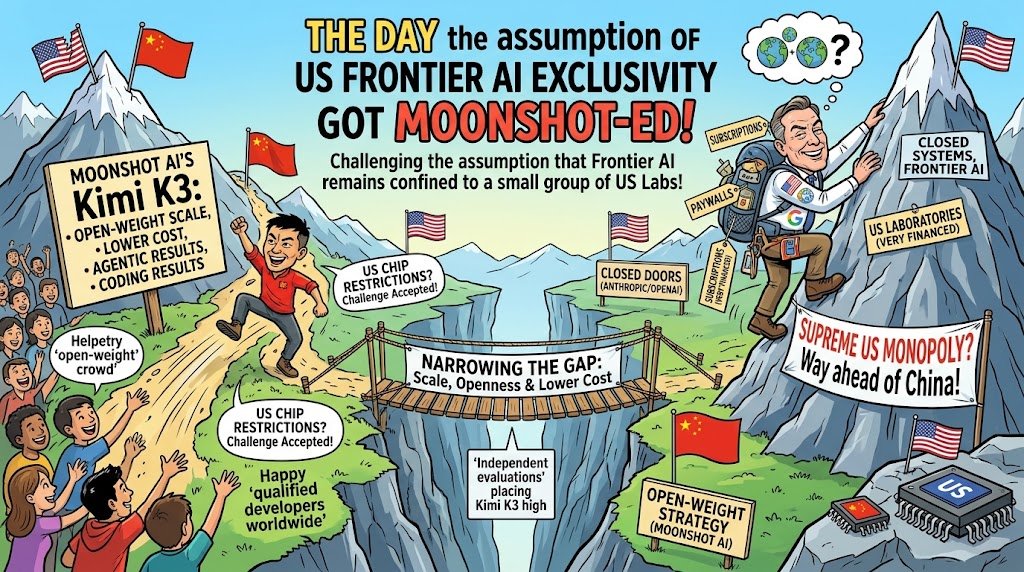
The Chinese start-up’s new open-weight model posts competitive coding and agentic results against leading American systems, challenging the assumption that frontier artificial intelligence remains confined to a small group of United States laboratories.
Moonshot AI has released Kimi K3, a large open-weight artificial intelligence model designed to compete directly with the strongest systems produced by Anthropic, OpenAI and other American laboratories.
The Beijing start-up says the model contains about two point eight trillion parameters and delivers frontier-level performance in coding, reasoning and autonomous tool use while remaining substantially cheaper to access than many proprietary rivals.
The release matters because Anthropic has built a powerful lead in professional coding and agentic work, particularly through its Claude family.
Kimi K3 does not conclusively displace that lead across every task.
It does, however, perform closely enough on several prominent evaluations to weaken the longstanding assumption that Chinese developers remain many months behind the American frontier.
Moonshot has published benchmark results showing Kimi K3 outperforming or matching selected versions of Claude and ChatGPT on coding, software engineering and general reasoning tests.
Independent public evaluations have also placed it among the strongest systems for front-end programming and complex instruction following.
Benchmark comparisons require caution: results vary with prompts, evaluation settings, tool access and the specific model versions selected for comparison.
A high score on one test does not establish universal superiority.
The central competitive advantage is the combination of capability and openness.
Kimi K3 is being distributed as an open-weight model, allowing qualified developers and companies to download, inspect, adapt and deploy it on their own infrastructure within the terms of its licence.
Anthropic’s most advanced models remain closed systems accessed through subscriptions and application programming interfaces, giving Anthropic greater control but offering customers less technical independence.
For businesses, that distinction can be decisive.
Open weights permit private deployment, specialized fine-tuning and tighter control over sensitive information.
They also reduce dependence on a single provider’s pricing, availability and product rules.
Running a model of Kimi K3’s scale still demands formidable computing resources, meaning most users will consume it through hosted services or compressed variants rather than operate the complete system independently.
Kimi K3 uses a mixture-of-experts architecture, in which only a portion of the model’s total parameters is activated for each token.
This design allows developers to increase overall capacity without incurring the full computational cost of running every parameter for every request.
The architecture does not make inference inexpensive, but it improves the relationship between model size, performance and operating cost.
Moonshot’s pricing is part of the challenge to American incumbents.
Chinese laboratories have increasingly offered capable models at sharply lower application programming interface rates, forcing customers to ask whether modest performance differences justify substantial price premiums.
For routine coding, document processing, customer support and workflow automation, cost and deployability can matter more than achieving the highest possible score on an elite reasoning benchmark.
The model also reflects China’s broader open-weight strategy.
DeepSeek, Alibaba, Zhipu and other developers have released systems that can be modified and incorporated into third-party products.
This approach accelerates adoption because researchers and companies can build on the models without routing every interaction through the original laboratory.
It also creates an international developer ecosystem that may persist even where Chinese consumer applications face political or regulatory restrictions.
American companies retain important advantages.
Anthropic and OpenAI have mature commercial platforms, extensive enterprise relationships, sophisticated safety systems and access to enormous computing infrastructure.
Their models are deeply integrated into software development tools and corporate workflows.
Anthropic’s strongest systems continue to lead on some demanding coding and long-horizon agent tasks, and public benchmark claims do not fully measure reliability, security or performance in production environments.
The competitive gap is nevertheless becoming harder to describe as a simple national hierarchy.
United States export controls have restricted China’s access to the most advanced artificial intelligence chips, but they have also encouraged Chinese laboratories to improve training efficiency, model architecture and hardware utilization.
Kimi K3 is evidence that limited access to top-tier processors can slow development without preventing highly competitive results.
Questions surrounding training data and model development remain contentious.
American laboratories have accused some Chinese companies of using outputs from proprietary models to improve competing systems through a process known as distillation.
Chinese developers have disputed allegations of improper conduct.
Distillation is a standard technical method when performed with authorized data, but it becomes legally and commercially contested when outputs are collected in violation of access conditions or used to reproduce protected capabilities.
Moonshot itself has emerged from a crowded field of Chinese artificial intelligence start-ups.
Founded by researcher Yang Zhilin and colleagues, the company first gained recognition through Kimi’s unusually long context window and later through open models aimed at coding and autonomous agents.
Its backers have included major Chinese technology investors, giving it resources to pursue model training at a scale unavailable to most independent laboratories.
The immediate consequence of Kimi K3 is not that Anthropic has lost its leadership.
It is that customers now have another credible option near the frontier, with a different economic and technical proposition.
Anthropic offers polished closed systems with strong enterprise support.
Moonshot is offering powerful downloadable weights, aggressive pricing and greater deployment freedom.
That rivalry will increasingly be decided outside benchmark tables.
Enterprises will compare error rates, coding reliability, cybersecurity, data governance, latency and the cost of operating models at scale.
Developers will measure how well each system handles long projects rather than isolated test questions.
Governments will examine whether open access expands innovation or creates new security risks.
Kimi K3 has therefore changed the competitive threshold.
A Chinese start-up has produced an open model capable of contesting work once dominated by the most heavily financed American laboratories, and its public release gives developers worldwide the means to test that claim directly.
AI Disclaimer: An advanced artificial intelligence (AI) system generated the content of this page on its own. This innovative technology conducts extensive research from a variety of reliable sources, performs rigorous fact-checking and verification, cleans up and balances biased or manipulated content, and presents a minimal factual summary that is just enough yet essential for you to function as an informed and educated citizen. Please keep in mind, however, that this system is an evolving technology, and as a result, the article may contain accidental inaccuracies or errors. We urge you to help us improve our site by reporting any inaccuracies you find using the "Contact Us" link at the bottom of this page. Your helpful feedback helps us improve our system and deliver more precise content. When you find an article of interest here, please look for the full and extensive coverage of this topic in traditional news sources, as they are written by professional journalists that we try to support, not replace. We appreciate your understanding and assistance.