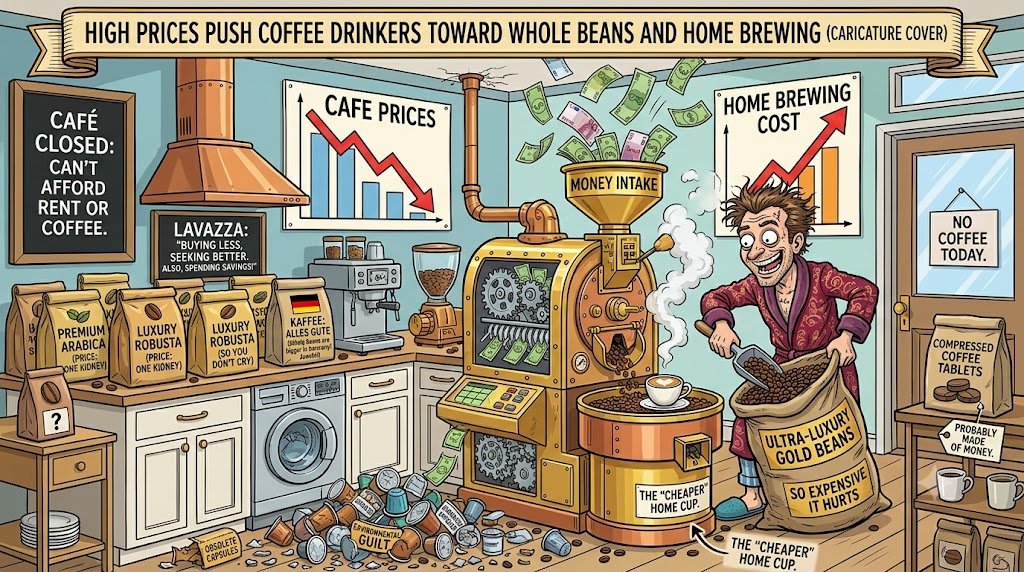
High Prices Push Coffee Drinkers Toward Whole Beans and Home Brewing
Lavazza says consumers are buying less but seeking better coffee, accelerating demand for whole beans and bean-to-cup machines across major European markets.
Four years of disruption in the global coffee market are reshaping what consumers brew at home.
After poor harvests and volatile commodity trading drove arabica and robusta prices to record levels in 2025, shoppers are increasingly choosing whole beans and equipment capable of producing café-style drinks rather than simply abandoning coffee altogether.
Lavazza chairman Giuseppe Lavazza described the migration toward beans as the industry’s most important consumer trend.
His assessment is that households are buying less but seeking better quality, investing in bean-to-cup machines to reproduce the experience of coffee shops in their kitchens.
The change is particularly pronounced in Britain.
Whole-bean sales rose 20.3 percent by volume in the year to May 2026, compared with growth of 2.8 percent across the broader market for coffee consumed at home.
The value of bean sales increased 36.8 percent, reflecting both higher demand and elevated retail prices.
Unit sales of bean-to-cup machines climbed 33.5 percent over the same period.
The figures suggest that higher prices are prompting a change in priorities rather than a uniform retreat from premium coffee.
Whole beans allow consumers to grind coffee immediately before brewing and adjust the strength, quantity and preparation method.
Modern automatic machines can also produce cappuccinos, flat whites and longer drinks with limited manual work, narrowing the practical difference between home preparation and a café purchase.
The pattern extends across continental Europe.
Whole-bean sales increased by value by 35 percent in France, 33 percent in Italy and 31.2 percent in Germany during the year to May. Germany, Europe’s largest coffee-consuming market, has advanced furthest: whole beans now constitute a larger segment than traditional pre-ground roasted coffee.
The change began before the latest price shock but accelerated during the coronavirus pandemic.
Café closures and widespread home working encouraged households to buy grinders, espresso makers and fully automatic machines.
Continued growth in both equipment and bean sales indicates that the habit persisted after offices and hospitality businesses reopened.
For roasters, the shift comes during an unusually difficult pricing cycle.
Adverse weather and disappointing crops in Brazil and Vietnam, the two largest producing countries, tightened supplies of arabica and robusta.
Because both varieties became expensive at the same time, manufacturers had less scope to reduce costs by substituting robusta, traditionally the cheaper component used in instant coffee and many espresso blends, for higher-priced arabica.
Commodity prices have since retreated from their 2025 peaks as supplies began to recover.
Arabica prices are projected to decline during 2026 after rising more than 40 percent in 2025, while robusta is also expected to fall.
Yet retail prices respond more slowly because roasters purchase beans in advance, carry inventories acquired at different costs and remain exposed to currency movements, shipping expenses and renewed weather disruption.
Lavazza therefore does not expect a rapid reduction in supermarket prices.
The company regards persistent volatility, rather than any single price level, as the market’s defining condition.
Heavy rain in Brazil could damage crops or delay harvesting, while a stronger El Niño weather pattern could disrupt production in other growing regions.
British prices for coffee consumed at home rose another 6.3 percent in the year to May. The simultaneous increase in bean volumes shows that at least part of the market is absorbing the pressure by concentrating spending on products perceived to deliver a better experience, even if consumers prepare fewer servings or reduce purchases elsewhere.
The upheaval has increased Lavazza’s revenue while also raising its costs.
The family-owned Italian group recorded revenue of €3.9 billion in 2025, an increase of 15.7 percent.
Core profit rose 8.8 percent to €340 million, with particularly strong growth in North America.
Higher selling prices contributed to the revenue increase, while weaker global volumes and expensive raw materials constrained the benefit to earnings.
Changing preferences are also challenging the capsule market.
Single-serve pods offer convenience, but their packaging has attracted environmental criticism, and demand has weakened in some markets as consumers adopt automatic bean machines.
Lavazza is responding with Tablì, a proprietary system that uses compressed tablets made entirely from coffee, without a plastic or aluminium capsule, individual wrapper, coating or binder.
The system, introduced first in Italy, is being expanded into the United States in 2026 as Lavazza’s largest investment in that market.
It requires a dedicated machine and is intended to preserve single-serving convenience while eliminating the conventional pod.
The launch places Lavazza behind two parallel bets: continued growth in whole-bean brewing and demand for a lower-packaging alternative among consumers who still prefer single-cup machines.
After poor harvests and volatile commodity trading drove arabica and robusta prices to record levels in 2025, shoppers are increasingly choosing whole beans and equipment capable of producing café-style drinks rather than simply abandoning coffee altogether.
Lavazza chairman Giuseppe Lavazza described the migration toward beans as the industry’s most important consumer trend.
His assessment is that households are buying less but seeking better quality, investing in bean-to-cup machines to reproduce the experience of coffee shops in their kitchens.
The change is particularly pronounced in Britain.
Whole-bean sales rose 20.3 percent by volume in the year to May 2026, compared with growth of 2.8 percent across the broader market for coffee consumed at home.
The value of bean sales increased 36.8 percent, reflecting both higher demand and elevated retail prices.
Unit sales of bean-to-cup machines climbed 33.5 percent over the same period.
The figures suggest that higher prices are prompting a change in priorities rather than a uniform retreat from premium coffee.
Whole beans allow consumers to grind coffee immediately before brewing and adjust the strength, quantity and preparation method.
Modern automatic machines can also produce cappuccinos, flat whites and longer drinks with limited manual work, narrowing the practical difference between home preparation and a café purchase.
The pattern extends across continental Europe.
Whole-bean sales increased by value by 35 percent in France, 33 percent in Italy and 31.2 percent in Germany during the year to May. Germany, Europe’s largest coffee-consuming market, has advanced furthest: whole beans now constitute a larger segment than traditional pre-ground roasted coffee.
The change began before the latest price shock but accelerated during the coronavirus pandemic.
Café closures and widespread home working encouraged households to buy grinders, espresso makers and fully automatic machines.
Continued growth in both equipment and bean sales indicates that the habit persisted after offices and hospitality businesses reopened.
For roasters, the shift comes during an unusually difficult pricing cycle.
Adverse weather and disappointing crops in Brazil and Vietnam, the two largest producing countries, tightened supplies of arabica and robusta.
Because both varieties became expensive at the same time, manufacturers had less scope to reduce costs by substituting robusta, traditionally the cheaper component used in instant coffee and many espresso blends, for higher-priced arabica.
Commodity prices have since retreated from their 2025 peaks as supplies began to recover.
Arabica prices are projected to decline during 2026 after rising more than 40 percent in 2025, while robusta is also expected to fall.
Yet retail prices respond more slowly because roasters purchase beans in advance, carry inventories acquired at different costs and remain exposed to currency movements, shipping expenses and renewed weather disruption.
Lavazza therefore does not expect a rapid reduction in supermarket prices.
The company regards persistent volatility, rather than any single price level, as the market’s defining condition.
Heavy rain in Brazil could damage crops or delay harvesting, while a stronger El Niño weather pattern could disrupt production in other growing regions.
British prices for coffee consumed at home rose another 6.3 percent in the year to May. The simultaneous increase in bean volumes shows that at least part of the market is absorbing the pressure by concentrating spending on products perceived to deliver a better experience, even if consumers prepare fewer servings or reduce purchases elsewhere.
The upheaval has increased Lavazza’s revenue while also raising its costs.
The family-owned Italian group recorded revenue of €3.9 billion in 2025, an increase of 15.7 percent.
Core profit rose 8.8 percent to €340 million, with particularly strong growth in North America.
Higher selling prices contributed to the revenue increase, while weaker global volumes and expensive raw materials constrained the benefit to earnings.
Changing preferences are also challenging the capsule market.
Single-serve pods offer convenience, but their packaging has attracted environmental criticism, and demand has weakened in some markets as consumers adopt automatic bean machines.
Lavazza is responding with Tablì, a proprietary system that uses compressed tablets made entirely from coffee, without a plastic or aluminium capsule, individual wrapper, coating or binder.
The system, introduced first in Italy, is being expanded into the United States in 2026 as Lavazza’s largest investment in that market.
It requires a dedicated machine and is intended to preserve single-serving convenience while eliminating the conventional pod.
The launch places Lavazza behind two parallel bets: continued growth in whole-bean brewing and demand for a lower-packaging alternative among consumers who still prefer single-cup machines.
AI Disclaimer: An advanced artificial intelligence (AI) system generated the content of this page on its own. This innovative technology conducts extensive research from a variety of reliable sources, performs rigorous fact-checking and verification, cleans up and balances biased or manipulated content, and presents a minimal factual summary that is just enough yet essential for you to function as an informed and educated citizen. Please keep in mind, however, that this system is an evolving technology, and as a result, the article may contain accidental inaccuracies or errors. We urge you to help us improve our site by reporting any inaccuracies you find using the "Contact Us" link at the bottom of this page. Your helpful feedback helps us improve our system and deliver more precise content. When you find an article of interest here, please look for the full and extensive coverage of this topic in traditional news sources, as they are written by professional journalists that we try to support, not replace. We appreciate your understanding and assistance.