
Nvidia Reportedly Takes Vast Texas Data-Centre Lease to Underwrite AI Expansion
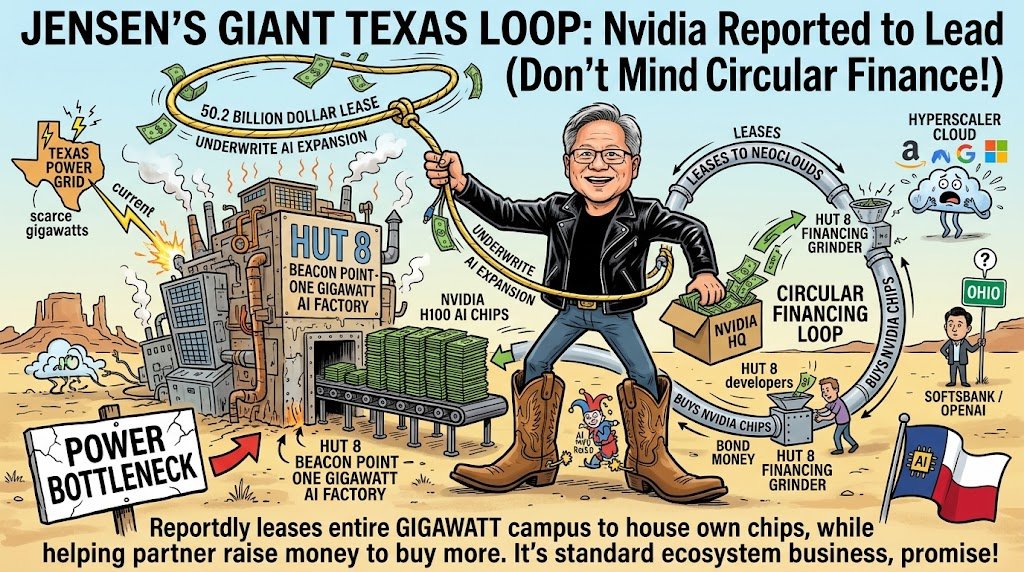
The chipmaker is said to be the tenant behind a lease worth up to 50.2 billion dollars at Hut 8’s one-gigawatt Beacon Point campus, a structure that has renewed concern over circular AI financing.
Nvidia has reportedly committed to lease a one-gigawatt Texas data-centre campus being developed by Hut 8, using its balance sheet to support a project expected to house hundreds of thousands of its own artificial-intelligence chips.
The arrangement would mark a significant broadening of Nvidia’s role in the artificial-intelligence economy.
The company has been the dominant supplier of the processors that power advanced model training and inference.
It is now reported to be stepping closer to the financing and operation of the physical infrastructure in which those processors will run.
Hut 8 disclosed last week that its Beacon Point campus had secured a contract with an existing investment-grade customer, but it did not identify the tenant.
The base term of the contract is valued at 19.6 billion dollars over 15 years.
If extension options are exercised, the total value could rise to 50.2 billion dollars across 30 years.
Nvidia has not publicly confirmed that it is the tenant.
Its response has been that it is working with ecosystem partners to accelerate the deployment of efficient artificial-intelligence infrastructure through its DSX AI factory architecture.
The reported identity of the tenant should therefore be treated as unconfirmed by the companies themselves, even though the financial terms and the existence of the underlying Hut 8 contract have been disclosed.
The campus is unusual in scale.
One gigawatt of electricity capacity is sufficient to support a vast concentration of high-performance computing, cooling equipment and network infrastructure.
Access to power has become one of the principal constraints on artificial-intelligence expansion, often more difficult to secure than land, buildings or even chips.
A project with assured electricity at this level is consequently a valuable strategic asset.
Nvidia is expected to use the facility directly or sublease capacity to so-called neocloud operators: specialist cloud companies that buy Nvidia processors and rent computing power to artificial-intelligence developers.
This would help create an alternative distribution channel to the established hyperscale cloud providers, such as Amazon, Google and Microsoft, while keeping Nvidia hardware at the centre of the emerging market.
The financial mechanics are as consequential as the technology.
Nvidia’s long-term lease commitment helped Hut 8 raise approximately 4.3 billion dollars in bond financing for the first phase of Beacon Point.
The presence of a tenant with Nvidia’s credit standing gave lenders greater confidence that the data-centre developer would have dependable revenue, allowing the bonds to secure investment-grade ratings and lower borrowing costs.
That structure is commercially rational.
A data-centre developer needs capital to build facilities; a chipmaker needs customers with power, buildings and financing sufficient to deploy its equipment; cloud providers need capacity to meet demand from artificial-intelligence companies.
A long-term lease can connect all three.
It has also revived concern over circular financing.
The risk is that a chipmaker supports the funding of a customer or infrastructure partner, which then uses that financial support to buy or host large quantities of the chipmaker’s products.
Revenue may be real and contracts may be enforceable, but investors must determine whether demand is ultimately coming from end users with sustainable business models or from an investment cycle that relies on continued financing by the suppliers themselves.
Nvidia’s supporters argue that the company is solving an infrastructure bottleneck rather than manufacturing demand.
Artificial-intelligence workloads require specialised power, cooling, networking and software integration.
If available data-centre capacity lags behind demand for chips, a strategic lease can speed deployment and allow more customers to access computing without each building a separate facility.
Critics respond that the distinction is not always clean.
Nvidia benefits twice if it helps bring a project into being: first through the deployment of its processors and again through the creation of new cloud capacity that may buy more of those processors.
The test will be whether the eventual subtenants generate sufficient customer revenue to make the chain of leases, bonds and hardware purchases self-sustaining.
The move is consistent with Jensen Huang’s wider strategy of making Nvidia an infrastructure platform rather than a component supplier alone.
DSX, the company’s AI factory architecture, combines Nvidia processors, networking, software and reference designs with equipment and services from partners.
The aim is to make the deployment of large-scale artificial-intelligence computing more standardised, faster and less operationally risky.
Nvidia has also been linked to discussions over a possible financial backstop for a much larger, ten-gigawatt data-centre project in Ohio associated with SoftBank and OpenAI.
That reported arrangement, valued at up to 250 billion dollars, has not been finalised.
Together with the Texas lease, it illustrates how the boundaries between chipmaker, financier, landlord, cloud operator and customer are becoming less distinct in the race to build artificial-intelligence capacity.
The commercial stakes are high.
Building data centres at this scale requires billions of dollars before a single artificial-intelligence workload is run.
Developers must secure land, transmission links, substations, water or other cooling systems, equipment and construction finance.
Artificial-intelligence providers, meanwhile, require enough computing capacity to train larger models and serve growing numbers of users without delays.
Nvidia’s reported Texas commitment gives Hut 8 a powerful anchor tenant and provides Nvidia with access to scarce, large-scale capacity.
It also places more of the financial risk of artificial-intelligence expansion within Nvidia’s commercial orbit, making future scrutiny of utilisation, subleasing and customer demand inevitable.
Construction and financing of the Beacon Point campus are proceeding around the disclosed long-term contract.
The next measure of the strategy will be whether the facility attracts sufficient paying artificial-intelligence workloads to justify both the data-centre investment and the vast quantity of Nvidia hardware expected to occupy it.
The arrangement would mark a significant broadening of Nvidia’s role in the artificial-intelligence economy.
The company has been the dominant supplier of the processors that power advanced model training and inference.
It is now reported to be stepping closer to the financing and operation of the physical infrastructure in which those processors will run.
Hut 8 disclosed last week that its Beacon Point campus had secured a contract with an existing investment-grade customer, but it did not identify the tenant.
The base term of the contract is valued at 19.6 billion dollars over 15 years.
If extension options are exercised, the total value could rise to 50.2 billion dollars across 30 years.
Nvidia has not publicly confirmed that it is the tenant.
Its response has been that it is working with ecosystem partners to accelerate the deployment of efficient artificial-intelligence infrastructure through its DSX AI factory architecture.
The reported identity of the tenant should therefore be treated as unconfirmed by the companies themselves, even though the financial terms and the existence of the underlying Hut 8 contract have been disclosed.
The campus is unusual in scale.
One gigawatt of electricity capacity is sufficient to support a vast concentration of high-performance computing, cooling equipment and network infrastructure.
Access to power has become one of the principal constraints on artificial-intelligence expansion, often more difficult to secure than land, buildings or even chips.
A project with assured electricity at this level is consequently a valuable strategic asset.
Nvidia is expected to use the facility directly or sublease capacity to so-called neocloud operators: specialist cloud companies that buy Nvidia processors and rent computing power to artificial-intelligence developers.
This would help create an alternative distribution channel to the established hyperscale cloud providers, such as Amazon, Google and Microsoft, while keeping Nvidia hardware at the centre of the emerging market.
The financial mechanics are as consequential as the technology.
Nvidia’s long-term lease commitment helped Hut 8 raise approximately 4.3 billion dollars in bond financing for the first phase of Beacon Point.
The presence of a tenant with Nvidia’s credit standing gave lenders greater confidence that the data-centre developer would have dependable revenue, allowing the bonds to secure investment-grade ratings and lower borrowing costs.
That structure is commercially rational.
A data-centre developer needs capital to build facilities; a chipmaker needs customers with power, buildings and financing sufficient to deploy its equipment; cloud providers need capacity to meet demand from artificial-intelligence companies.
A long-term lease can connect all three.
It has also revived concern over circular financing.
The risk is that a chipmaker supports the funding of a customer or infrastructure partner, which then uses that financial support to buy or host large quantities of the chipmaker’s products.
Revenue may be real and contracts may be enforceable, but investors must determine whether demand is ultimately coming from end users with sustainable business models or from an investment cycle that relies on continued financing by the suppliers themselves.
Nvidia’s supporters argue that the company is solving an infrastructure bottleneck rather than manufacturing demand.
Artificial-intelligence workloads require specialised power, cooling, networking and software integration.
If available data-centre capacity lags behind demand for chips, a strategic lease can speed deployment and allow more customers to access computing without each building a separate facility.
Critics respond that the distinction is not always clean.
Nvidia benefits twice if it helps bring a project into being: first through the deployment of its processors and again through the creation of new cloud capacity that may buy more of those processors.
The test will be whether the eventual subtenants generate sufficient customer revenue to make the chain of leases, bonds and hardware purchases self-sustaining.
The move is consistent with Jensen Huang’s wider strategy of making Nvidia an infrastructure platform rather than a component supplier alone.
DSX, the company’s AI factory architecture, combines Nvidia processors, networking, software and reference designs with equipment and services from partners.
The aim is to make the deployment of large-scale artificial-intelligence computing more standardised, faster and less operationally risky.
Nvidia has also been linked to discussions over a possible financial backstop for a much larger, ten-gigawatt data-centre project in Ohio associated with SoftBank and OpenAI.
That reported arrangement, valued at up to 250 billion dollars, has not been finalised.
Together with the Texas lease, it illustrates how the boundaries between chipmaker, financier, landlord, cloud operator and customer are becoming less distinct in the race to build artificial-intelligence capacity.
The commercial stakes are high.
Building data centres at this scale requires billions of dollars before a single artificial-intelligence workload is run.
Developers must secure land, transmission links, substations, water or other cooling systems, equipment and construction finance.
Artificial-intelligence providers, meanwhile, require enough computing capacity to train larger models and serve growing numbers of users without delays.
Nvidia’s reported Texas commitment gives Hut 8 a powerful anchor tenant and provides Nvidia with access to scarce, large-scale capacity.
It also places more of the financial risk of artificial-intelligence expansion within Nvidia’s commercial orbit, making future scrutiny of utilisation, subleasing and customer demand inevitable.
Construction and financing of the Beacon Point campus are proceeding around the disclosed long-term contract.
The next measure of the strategy will be whether the facility attracts sufficient paying artificial-intelligence workloads to justify both the data-centre investment and the vast quantity of Nvidia hardware expected to occupy it.
AI Disclaimer: An advanced artificial intelligence (AI) system generated the content of this page on its own. This innovative technology conducts extensive research from a variety of reliable sources, performs rigorous fact-checking and verification, cleans up and balances biased or manipulated content, and presents a minimal factual summary that is just enough yet essential for you to function as an informed and educated citizen. Please keep in mind, however, that this system is an evolving technology, and as a result, the article may contain accidental inaccuracies or errors. We urge you to help us improve our site by reporting any inaccuracies you find using the "Contact Us" link at the bottom of this page. Your helpful feedback helps us improve our system and deliver more precise content. When you find an article of interest here, please look for the full and extensive coverage of this topic in traditional news sources, as they are written by professional journalists that we try to support, not replace. We appreciate your understanding and assistance.